This day in history
This day in history – 2 January
 Death anniversary of Sibbuyeh, an Iranian who wrote grammar and syntax for the Arabic language, and on this occasion a glimpse at the universal role of Persian literature
As per international historic documents Sibbuyeh, the famous Iranian linguist, died in the first week of January, AD 793, in Shiraz. He was born in a town in Shiraz called Bizaa, at a time which is not clearly known. The historic importance of Sibbuyeh is because he was the first Person who wrote grammar for Arabic language and added vowel signs on words (the signs for a, e & o in Arabic words was invented by Sibbuyeh). For this work Sibbuyeh became famous as the ‘Grammatical Sibbuyeh”. If Sibbuyeh had not done this work on the Arabic language, which was a master piece of his time, this language would not have grown and gained its present strength and stability. This is how Iranians wrote grammar for the Arabs.
Sibbuyeh means someone who smells apple. Its Arabic pronunciation is different.
On occasion of the demise anniversary of Sibbuyeh, a glimpse at the international role of Persian literature:
When the literature of a nation is studied, judging is done on its literature on the whole and all through history. In addition, when Persian literature is referred to, this means material that is written and compiled in verse and prose, fiction and non-fiction, all over Iran and also by Iranians and Persian speaking writers throughout the world and throughout history. The territory of Persian literature includes the whole of the ancient empire of Iran which was sacrificed in the 19th century because of colonial greed and competition of Europeans. Therefore, the literature of the present day Iran includes the whole of Central Asia, East Iran (Afghanistan upto the Indus River), Kashmir, Caucasia and the previous West Iran. We know that for many centuries, the language of the court of the Indian and Ottoman emperors and Indian and south Russian intellectuals was Persian and from these places we can take the names of Amir Khosrow Dehlavi and
Mohammad Iqbal as examples.
After Pakistan was established as a country its national anthem was written in Persian language, and at present, too, any text written by Persian speaking and Persian originated writers from Afghanistan, Tajikistan and any other place, is considered as Persian literature.
In all encyclopedias Persian literature is described as the most expansive literature in the whole world, which, by counting Avesta, has a history of 3000 years. Persian literature, especially in the medieval centuries, is of the best quality throughout history. The sociological value of Persian literature in the medieval centuries is because of its advices to all types of human beings, may they be adolescents or the powerful, etc. Abundance of verse in Persian literature has made this language, which shows the psychology and power of the minds of its people, is famous as the ‘language of verse’. And, we should owe this to the Sammanian dynasty and Ferdowsi and poets of the 9th upto 13th centuries AD, who mainly rose from East and Northeast Iran (Afghanistan and Central Asia) and Fars (Persia). It was this same language that distinguished Iranian music from the music of other nations. The literature of a nation will not keep to
conventional borders and as a result is the proof of the identity and unity of a nation to whom this literature belongs and they share its ownership. It is a source of great honor that the book named Ghaboosnameh (Kavoosnameh) which was written 11 centuries ago by a Mazandaran prince from the Ziarian dynasty was translated into many languages; first into Greek, and then into Hebrew, Spanish, Latin (ancient Italian), German, English (by Sir Thomas North), French, and. . .
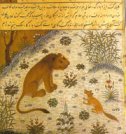
We should also know that literature was born in the Arab world by translation of Kelileh & Demneh (Samson & Delilah) from Sassanid Persian into Arabic, in the 8th century AD by Roozbeh (Ibn Al-Muqafaa). Despite this valuable service of Roozbeh he was executed by Mansour, the Abbasid Caliph who had gained power with the military and political assistance of Iranians!
If Sibbuyeh had not written grammar for the Arabic language, it would have lost its stability and unchanging character, like a dialect.
Translation by Rowshan Lohrasbpour